I've Reviewed 500+ Trading Portfolios. These 5 Mistakes Show Up Every Single Time.
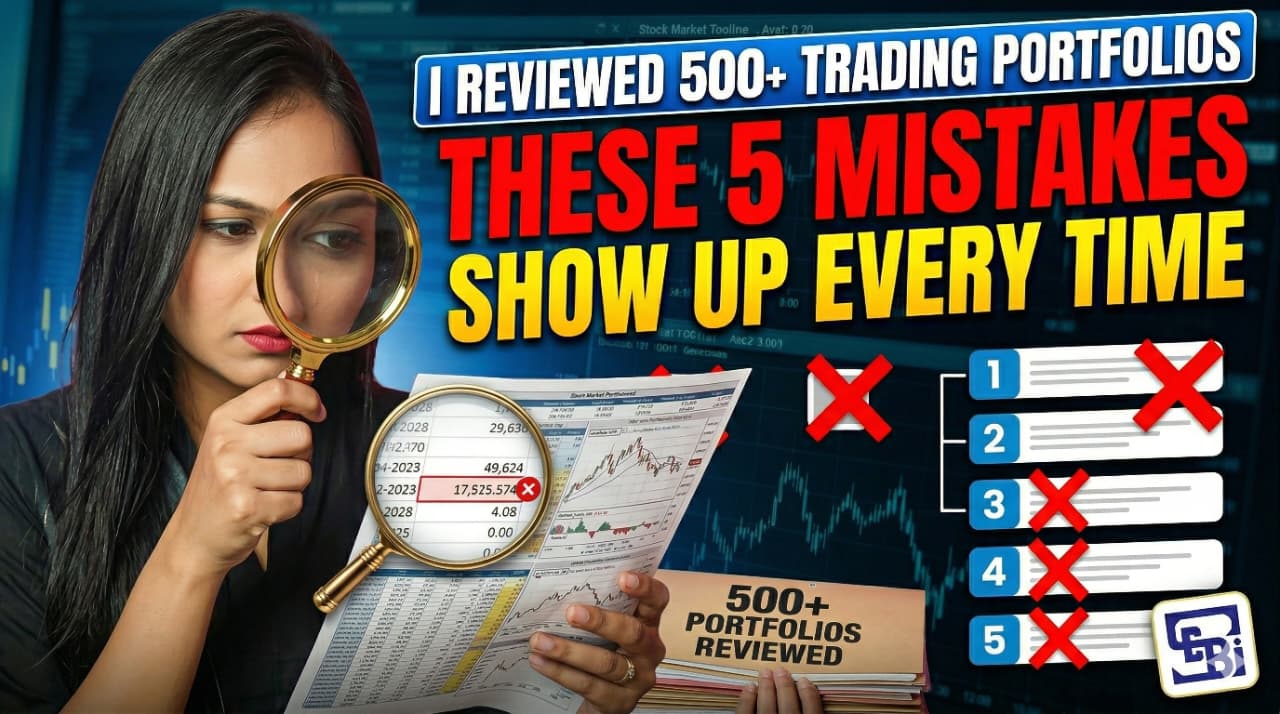
When you've sat across from enough traders and looked at enough portfolios, patterns start becoming impossible to ignore.
Over 6 years of mentoring, I've reviewed hundreds of portfolios. Different cities, different age groups, different capital sizes. A 24 year old software engineer in Pune. A 45 year old businessman in Delhi. A homemaker in Mumbai who started investing during the pandemic.
All different people. Almost always, the same mistakes.
Here they are honestly, without sugarcoating.
Mistake 1: Too many stocks, no real conviction in any of them
The average portfolio I review has 18 to 25 stocks in it.
Ask the person why they own any specific one and the answer is usually vague. “Someone recommended it.” “I read about it somewhere.” “It looked good at the time.”
A portfolio built this way isn't diversification. It's confusion dressed up as a strategy. Real diversification means owning different businesses for different specific reasons — not collecting stocks the way you collect contacts on your phone.
If you cannot clearly explain why you own something in 2 sentences, you probably shouldn't own it.
Mistake 2: No exit plan, ever
People spend enormous energy deciding what to buy. Almost nobody decides in advance when they will sell.
No target price. No stop loss. No rule for what would change their mind.
So what happens? They hold winners too briefly because any profit feels like it might disappear. They hold losers indefinitely because selling means admitting the decision was wrong.
The entry is 20% of the job. The exit is 80%. Most people have it completely backwards.
Mistake 3: Averaging down on bad businesses
“Main average kar leta hoon” is one of the most dangerous sentences in retail investing.
Averaging down — buying more of a stock as it falls — only makes sense if the business is genuinely strong and the fall is due to market wide selling rather than company specific problems.
Most people average down on exactly the wrong stocks. The ones falling because the business is deteriorating. The ones where the original thesis was already wrong. They turn a small mistake into a large one by adding more capital to a broken story.
Mistake 4: Watching the portfolio instead of watching the business
Checking your portfolio 8 times a day is not research. It is anxiety.
The price on your screen tells you what the market is currently willing to pay for a business. It does not tell you whether the business itself is doing well or poorly.
The investors who actually build wealth check their portfolio far less than you'd expect. They spend that time instead on understanding what is happening inside the businesses they own — quarterly results, management commentary, sector developments.
Price follows business quality, always. Eventually.
Mistake 5: Learning from outcomes instead of process
This one is subtle but it destroys more traders than almost anything else.
If you made money on a trade, most people assume their process was correct. If they lost, they assume the market was wrong or they were unlucky.
But a bad process can produce a good outcome by chance. And a good process can produce a bad outcome because of factors outside your control.
The only way to actually improve as a trader or investor is to evaluate your process after every trade — not just the result. Did I follow my rules? Did I manage my risk correctly? Would I take this trade again given what I knew at the time?
That honest self assessment, done consistently, is what separates traders who grow from traders who just keep repeating the same expensive lessons.
None of these mistakes are about intelligence. Every single person I have seen make them is smart, motivated, and genuinely wants to do well in markets. The problem is never capability. It is always the absence of a structured framework that was built before emotions got involved.
Woh framework — that is exactly what I help people build.
If you recognise yourself in any of these mistakes and want to build a real process around your trading and investing, my mentorship programme is the right next step.